• About

N1nja Hacks

~ Random assortment of solutions, sneaky hacks and technical HOWTOs

N1nja Hacks

Author Archives: valblant

jQuery Conflicts or Re-routing JSF resource requests with RichFaces Resource Mapping

01 Wednesday May 2013

Posted by valblant in JSF, RichFaces

≈ 1 Comment

If you are using RichFaces and you ever need to resolve a resource conflict (like a conflicting version of jQuery, for example), you need to read this article:
http://rik-ansikter.blogspot.ca/2012/02/re-routing-jsf-resource-requests-with.html

There is even an example implementation provided:
https://github.com/camra/Richfaces-Primefaces-Problem

Ajax, JSF 2 and ClientBehaviors

30 Tuesday Apr 2013

Posted by valblant in JSF

≈ Leave a comment

I consider myself to have a fairly expert understanding of JSF-related technologies, so it is becoming rare that I come across articles that teach me something new about the subject. However, I have come across just such a pair of articles, so I thought I’d share. These provide an excellent overview of the subjects and it is thorough enough that I learned some new things that I never came across before.

“Ajax and JSF, Joined At Last” by Jay Balunas

“Introducing JSF 2 Client Behaviors” by Dan Allen

Using CGLIB proxies to create efficient wrappers

29 Monday Apr 2013

Posted by valblant in CGLIB, JSF, RichFaces

≈ Leave a comment

Tags

cglib, JSF

I was recently faced with a problem that encouraged me to look into CGLIB proxies. What I needed to do was to slightly modify the way a RichFaces component rendered a partial response (an AJAX response). The change was very small, yet the only way to do it with traditional methods would be to override a RichFaces class, copy-and-paste a large method and make the necessary changes there.

I did not want to go in that direction, b/c that would make my code very sensitive to changes in future versions of RichFaces. Instead I decided to explore the possibility of somehow intercepting a call to PartialResponseWriter.startUpdate() method, b/c that was the behaviour I needed to change.

The obvious strategy here would be to create a wrapper around the PartialResponseWriter and make the necessary changes in the method I need. The problem with this approach is that my wrapper would have to implement about 20 methods, all of which except for one would be useless pass-throughs. That’s a lot of boilerplate there. A Lazy Programmer such as myself would never actually spend the time writing all that useless code. So, I decided to see if I could achieve my goal by utilizing CGLIB proxies.

CGLIB

CGLIB is a powerful and performant bytecode generation library, that relies on the low-level ASM framework (http://asm.ow2.org/). If you ever used Spring AOP or Hibernate, than you are probably used to seeing CGLIB proxied objects all the time.

CGLIB codebase is small, but not well documented, so it took me some time to figure out how to create some simple proxies.

Creating a Simple Proxy

Unlike the JDK dynamic proxy, we cannot proxy an existing object. The target object must be created by the CGLIB library, so all we get to do is specify the superclass for our proxy, as well as which constructor to use, if any.

The core of the CGLIB proxying API is the net.sf.cglib.proxy.Enhancer class. It has a lot of helper method for different situations. You can easily explore these options by looking at the source code for that class. In my example here I’ll show how to create a proxy for PartialResponseWriter, which has no default constructor:

private PartialResponseWriter proxyResponseWriter(PartialResponseWriter origWriter) {
	Enhancer enhancer = new Enhancer();
	enhancer.setSuperclass(PartialResponseWriter.class);
	enhancer.setCallback(new ResponseWriterInterceptor(origWriter));
		
	PartialResponseWriter proxy = (PartialResponseWriter) enhancer.create(
			new Class[] {ResponseWriter.class}, 
			new Object[] {origWriter.getWrapped()});
	
	return proxy;
}

private class ResponseWriterInterceptor implements MethodInterceptor {
	private PartialResponseWriter originalWriter;
	public ResponseWriterInterceptor(PartialResponseWriter originalWriter) {
		this.originalWriter = originalWriter;
	}

	public Object intercept(Object object, Method method, Object[] args, MethodProxy methodProxy) throws Throwable {
		if ( "startUpdate".equals(method.getName()) ) {
			String clientId = args[0].toString();
			
			if ( FixedUICollapsibleSubTable.this.getClientId().equals(clientId) ) { // Make sure the update is for our table
				clientId += ":c";
				return method.invoke(originalWriter, new Object[] {clientId});
			}
		}

		return method.invoke(originalWriter, args);
	}
}


This code creates a new instance of PartialResponseWriter and provides us with a way to examine and/or modify all calls to it via the provided MethodInterceptor. In this case I made the interceptor act as a pass-through for all methods, except startUpdate, which does additional processing before calling the proxied method.

The Final Hack

The final implementation of this hack was a bit more complex than proxying just the PartialResponseWriter, since RichFaces did not make it easy to “install” our proxied version of the ResponseWriter into the PartialViewContext, nevertheless this strategy worked out very well for me.

The two additional things I needed to do was CGLIB proxy ExtendedPartialViewContext as well, in order to get at the right spot to proxy PartialResponseWriter.

I also had to use reflection to set the resulting PartialResponseWriter proxy on the current FacesContext.

Here is the full code for the hack:

/**
* The ajax response modification allows us to re-render only the subtable we want on ajax requests, rather than
* the whole master table.
*
* @author Val Blant
*/
public class FixedUICollapsibleSubTable extends UICollapsibleSubTable {

/**
 * This method installs hooks into the <code>PartialResponseWriter</code> used to put together an ajax 
 * response that involves our Collapsible Sub Table. We use CGLIB proxies to intercept the startUpdate() 
 * call and manipulate the clientId used in writing the response.
 */
@Override
public boolean visitTree(VisitContext visitContext, VisitCallback callback) {
	FacesContext facesContext = FacesContext.getCurrentInstance();
	PartialViewContext viewContext = facesContext.getPartialViewContext();
	
	boolean magicEnabled = false;
	if ( visitContext instanceof RenderExtendedVisitContext ) { // Only do this for render phase
		if ( viewContext instanceof ExtendedPartialViewContext ) { // Should always be true unless RF4 changes something
			magicEnabled = true;

			// Proxy the View Context and set it into the FacesContext
			//
			ExtendedPartialViewContext proxy = proxyViewContext(viewContext);
			replaceViewContext(facesContext, proxy);
		}
		
	}
	
	// Visit the subtable with proxied PartialResponseWriter
	//
	boolean result = super.visitTree(visitContext, callback);
	
	// Restore the original objects
	//
	if ( magicEnabled ) {
		replaceViewContext(facesContext, viewContext);
	}
	
	return result;
}

/**
 * @param viewContext
 * @return CGLIB proxy of the passed in <code>PartialViewContext</code>
 * @see PartialViewContextInterceptor
 */
private ExtendedPartialViewContext proxyViewContext(PartialViewContext viewContext) {
	Enhancer enhancer = new Enhancer();
	enhancer.setSuperclass(ExtendedPartialViewContext.class);
	enhancer.setCallback(new PartialViewContextInterceptor((ExtendedPartialViewContext)viewContext));
	
	ExtendedPartialViewContext proxy = (ExtendedPartialViewContext) enhancer.create(
			new Class[] {FacesContext.class}, 
			new Object[] {FacesContext.getCurrentInstance()});
	
	return proxy;
}

/**
 * Replaces the <code>PartialViewContext</code> inside the given facesContext
 * 
 * @param facesContext
 * @param viewContext
 */
private void replaceViewContext(FacesContext facesContext, PartialViewContext viewContext) {
	try {
		Field f = facesContext.getClass().getDeclaredField("partialViewContext");
		f.setAccessible(true);
		f.set(facesContext, viewContext);
	} catch (Exception e) {
		throw new IllegalStateException(e);
	}
}


/**
 * Intercepts calls to getPartialResponseWriter() in order to return a proxied <code>PartialResponseWriter</code>
 * with our customizations.
 */
private class PartialViewContextInterceptor implements MethodInterceptor {
	private ExtendedPartialViewContext originalContext;
	public PartialViewContextInterceptor(ExtendedPartialViewContext originalContext) {
		this.originalContext = originalContext;
	}

	public Object intercept(Object object, Method method, Object[] args, MethodProxy methodProxy) throws Throwable {
		if ( "getPartialResponseWriter".equals(method.getName()) ) {
			return proxyResponseWriter();
		}
		else {
			return method.invoke(originalContext, args);
		}
	}
	
	/**
	 * @return CGLIB proxy of the <code>PartialResponseWriter</code>
	 * @see ResponseWriterInterceptor
	 */
	private PartialResponseWriter proxyResponseWriter() {
		PartialResponseWriter origWriter = originalContext.getPartialResponseWriter();
		Enhancer enhancer = new Enhancer();
		enhancer.setSuperclass(PartialResponseWriter.class);
		enhancer.setCallback(new ResponseWriterInterceptor(origWriter));
		
		PartialResponseWriter proxy = (PartialResponseWriter) enhancer.create(
				new Class[] {ResponseWriter.class}, 
				new Object[] {origWriter.getWrapped()});
		
		return proxy;
	}
	
}

/**
 * Intercepts calls to startUpdate() method in order to modify the clientId.
 * 
 * This is necessary, b/c we are no longer using the stock version of the Collapsible Sub Table from RF4.
 * We made a lot of modifications which change the HTML structure of the table. One change involves not rendering
 * the 'tbody' tag with id that matches the clientId of our subtable component. We are only rendering the content 
 * 'tbody', which has the id with form: "{clientId}:c".
 *  
 * The purpose of this interceptor is to make sure that the ajax update response targets the content 'tbody', rather than
 * now missing 'tbody'.
 */
private class ResponseWriterInterceptor implements MethodInterceptor {
	private PartialResponseWriter originalWriter;
	public ResponseWriterInterceptor(PartialResponseWriter originalWriter) {
		this.originalWriter = originalWriter;
	}

	public Object intercept(Object object, Method method, Object[] args, MethodProxy methodProxy) throws Throwable {
		if ( "startUpdate".equals(method.getName()) ) {
			String clientId = args[0].toString();
			
			if ( FixedUICollapsibleSubTable.this.getClientId().equals(clientId) ) { // Make sure the update is for our table
				clientId += ":c";
				return method.invoke(originalWriter, new Object[] {clientId});
			}
		}

		return method.invoke(originalWriter, args);
	}
}


}

Exporting H.264 from Cinelerra

11 Monday Mar 2013

Posted by valblant in video

≈ 6 Comments

Tags

video

This article will discuss creation of H.264 videos from Cinelerra on Ubuntu 12.04. A lot of the information was synthesized from
Olson Video and Websites.

Built-in H.264 Export

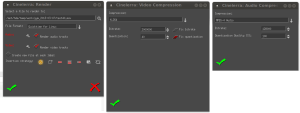
In the Renderer select “Quicktime for Linux”, and then use the H.264 compression option for video, and MPEG-4 Audio for sound:
01 H.264 - built-in

The problem with this approach is that Cinelerra provides very few settings to customize the encoding. I can achieve a much higher quality for the same size by using 2-pass encoding with the x264 utility. Luckily for us, Cinelerra has YUV4MPEG Stream option.

YUV4MPEG Stream

YUV4MPEG Stream allows us to pipe the video stream out of Cinelerra into an arbitrary tool chain. In this case the tool chain is my script that uses named pipes to encode the video with x264.

The script was adopted from here: http://www.renomath.org/ejolson/video/hddvd/264wf.html
I used http://www.renomath.org/ejolson/video/hddvd/pipe-x264 as a starting point.

Preparation

  1. Make sure that you have the x264 package installed.
  2. Save the code provided in the last section of this post as /usr/local/bin/pipe-x264.sh
  3. Make /usr/local/bin/pipe-x264.sh executable.
  4. Specify the desired resolution and FPS in the script. See code in the last section, which shows you which lines to modify.
  5. Cinelerra must be launched from the command line, so that you can see the console output.

Export Steps

1) Export The Sound

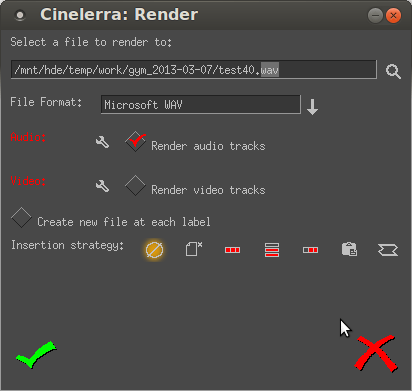
In the Renderer select “Microsoft WAV” for File Format, check Audio and uncheck Video. Export.
2) First Pass Video

In the Renderer select “YUV4MPEG Stream” for File Format, check Video and uncheck Audio. In the settings check “Use Pipe” and type the following:

$ /usr/local/bin/pipe-x264.sh -p 1 -b 1000 "%"
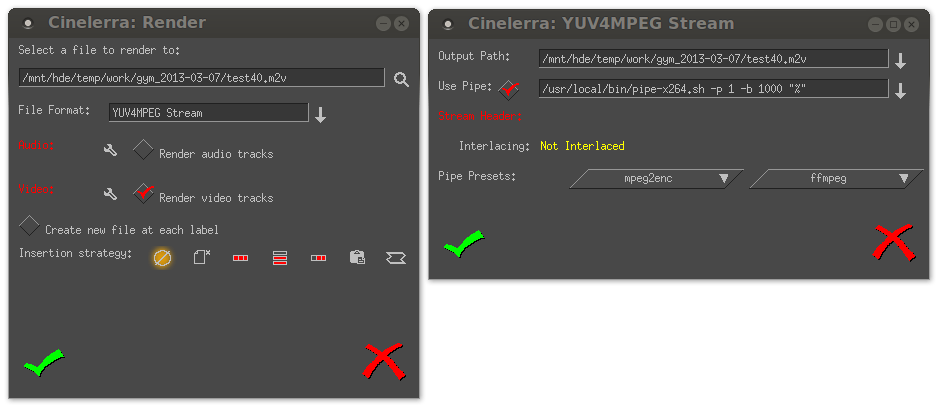
The first parameter (-p) is the pass number. The second (-b) is the bitrate you want. Make sure that the path points to where you’ve saved the script, that I’ll give you below.

If all works well, the video should start encoding. To check if it is actually working, you must launch Cinelerra from the command line and look at the console output after you start rendering. You should see x264 command call printed and x264 should be running and printing stuff to the console. If something went wrong, you’ll see an error instead. If you can’t figure out what’s wrong from the output, leave a comment and I might try to help.

The output in the console should look something like this:

Running pass 1:
     x264 /tmp/cine_pipe --input-res 1920x1080 --fps 59.9401 --bitrate 1000     --pass 1 --stats "/mnt/hde/temp/work/gym_2013-03-07/test40.stats"     --bframes 2 --b-adapt 2     --direct auto     --threads auto     --output "/mnt/hde/temp/work/gym_2013-03-07/test40.m2v"

[yuv4mpegpipe @ 0x15ae720] Estimating duration from bitrate, this may be inaccurate
lavf [info]: 1920x1080p 0:1 @ 60000/1001 fps (cfr)
x264 [info]: using cpu capabilities: MMX2 SSE2Fast SSSE3 FastShuffle SSE4.2
x264 [info]: profile Main, level 4.2
Render::render_single: Session finished.
x264 [info]: frame I:1     Avg QP:43.42  size: 10362
x264 [info]: frame P:49    Avg QP:39.33  size:  3682
x264 [info]: frame B:95    Avg QP:41.30  size:   788
x264 [info]: consecutive B-frames:  0.7%  4.1% 95.2%
x264 [info]: mb I  I16..4: 97.9%  0.0%  2.1%
x264 [info]: mb P  I16..4: 11.4%  0.0%  0.0%  P16..4:  9.3%  0.0%  0.0%  0.0%  0.0%    skip:79.2%
x264 [info]: mb B  I16..4:  0.7%  0.0%  0.0%  B16..8:  2.8%  0.0%  0.0%  direct: 1.0%  skip:95.6%  L0:39.7% L1:59.7% BI: 0.6%
x264 [info]: final ratefactor: 34.33
x264 [info]: direct mvs  spatial:88.4% temporal:11.6%
x264 [info]: coded y,uvDC,uvAC intra: 1.7% 25.6% 1.4% inter: 0.2% 1.5% 0.0%
x264 [info]: i16 v,h,dc,p: 46% 31% 16%  7%
x264 [info]: i4 v,h,dc,ddl,ddr,vr,hd,vl,hu: 16% 25% 36%  2%  3%  6% 10%  2%  1%
x264 [info]: i8c dc,h,v,p: 76% 12% 11%  2%
x264 [info]: Weighted P-Frames: Y:0.0% UV:0.0%
x264 [info]: kb/s:878.42

3) Second Pass Video

Once the first pass render is finished, go back to Video Settings in the Renderer and change the pipe command to run the second pass (-p 2):

$ /usr/local/bin/pipe-x264.sh -p 2 -b 1000 "%"

Again check the console to make sure that encoding has started.

4) Multiplex Video and Sound

The previous steps should have produced two files: test40.m2v and test40.wav. We need to multiplex them into a container:

$ ffmpeg -i test40.m2v -i test40.wav -acodec libmp3lame -ab 128k -ar 48000 -vcodec copy test40.avi

Here is a handy script to keep around for this step:

#!/bin/bash
# Multiplex video and sound
#

if [[ $# -lt 2 ]] ; then
    echo
    echo "  Usage: $0 <video file> <sound file>"
    echo
    exit 1
fi

command="ffmpeg -i $1 -i $2 -acodec libmp3lame -ab 128k -ar 48000 -vcodec copy ${1%%.*}.avi"

echo $command
eval $command

Mission Accomplished

You should now have a nice H.264 avi file.

Note that the .m2v file will probably not play correctly in any player, but that is ok, b/c after we multiplex it with sound the resulting file plays everywhere.

pipe-x264.sh

Please note that you have to set the desired resolution and framerate on the lines highlighted below.

#!/bin/bash
#
# Use this script to export H.264 videos from Cinelerra
#

# Change these to suite your needs
######## Canon G6 ##############
#frame_rate=10
#resolution=640x480
######## Sony A57 ##############
frame_rate=59.9401
resolution=1920x1080

pass=1
bit_rate=10000

help(){
    cat <<END
Usage: $0 [options] filename.anything
Options:
    -b n      bitrate n                             ($bit_rate)
    -p n      pass n                                ($pass)
    -h        Print this help message
END
    exit 0
}

while getopts b:p:h name "$@"
do
    case $name in
b)
	bit_rate=$OPTARG ;;
p)
	pass=$OPTARG ;;
*)
    help ;;
    esac
done
let shiftind=$OPTIND-1
shift $shiftind
if test "$#" != "1"
then
    help
fi

outfile=$1
base=`echo $outfile | sed "s/\.[^.]*$//"`

command="x264 /tmp/cine_pipe --input-res $resolution --fps $frame_rate --bitrate $bit_rate \
    --pass $pass --stats \"$base.stats\" \
    --bframes 2 --b-adapt 2 \
    --direct auto \
    --threads auto \
    --output \"$outfile\""

# Make a named pipe
rm /tmp/cine_pipe 2> /dev/null
mkfifo /tmp/cine_pipe

echo "Running pass $pass:"
echo "     $command"
echo

# Run the encoding command. It will block and wait for cat to start feeding data into the pipe
eval "$command &"

cat > /tmp/cine_pipe

Hope this helps.

Installing Cinelerra 4.4 on Ubuntu 12.04

09 Saturday Mar 2013

Posted by valblant in video

≈ 16 Comments

This article provides step-by-step instructions for installing Cinelerra 4.4.

I upgraded my main workstation to Ubuntu 12.04 recently, briefly looked at PiTiVi and decided that Cinelerra is still the only capable video editor for Linux, despite its many flaws.

This post provides step-by-step instructions for compiling and installing Cinelerra 4.4.

Install Dependencies

Here is the list of dependencies that I know about. At a minimum you’ll need these packages, although there may be more. If the compile fails on a dependency, simply look at the last few lines of the output and the error should tell you what it’s missing.

$ sudo apt-get install wget bzip2 patch build-essential w32codecs w64codecs libtool nasm libncurses5-dev libbz2-dev libncursesw5-dev libxv-dev libxxf86vm-dev libogg-dev libvorbis-dev libtheora-dev libopenexr-dev libdv-dev libpng-dev libjpeg62-dev libfreetype6-dev libfaad-dev libsndfile1-dev uuid-dev libavutil-dev libmpeg3-dev libavcodec-dev libx264-dev libfaac-dev libglu1-mesa-dev libmjpegtools-dev

Download Source

$ wget http://downloads.sourceforge.net/project/heroines/cinelerra-4.4-src.tar.xz
$ tar xvf cinelerra-4.4-src.tar.xz

You should now have a directory called cinelerra-4.4

Apply Patches

You will need to apply two patches from the Community Version of Cinelerra to add dnxhd and dv50 codec support and YUV Stream support. This was easy, b/c the patches applied cleanly.

$ wget http://renomath.org/video/linux/cinelerra/patch-cinelerra-4.4-dnxhd
$ wget http://renomath.org/video/linux/cinelerra/patch-cinelerra-4.4-yuvstream
$ patch -Np1 -d cinelerra-4.4 < patch-cinelerra-4.4-dnxhd
$ patch -Np1 -d cinelerra-4.4 < patch-cinelerra-4.4-yuvstream

I found out about these patches from Eric Olson’s site: http://renomath.org/video/linux/cinelerra/

Build

$ cd cinelerra-4.4
$ ./configure
$ make

The install target does not work, so don’t bother with it. After make succeeds, the Cinelerra binary will be in the bin/ folder. So, to run Cinelerra:

$ cd bin
# ./cinelerra

Importing AVCHD

I mostly use Cinelerra to work with AVCHD video from my Sony DSLR, which shoots at 1080p with 60 FPS. Cinelerra cannot read the resulting MTS files, so I have to convert them to dnxhd (AVdn) format first:

$ ffmpeg -i 00014-360_2.MTS -b 185M -vcodec dnxhd -acodec pcm_s16le -threads 4 output.mov

Also, I could not get Cinelerra to read the sound from the resulting file (complains about missing ‘lpcm’ codec), so I had to take another intermediate step to extract the audio from the file, so I can import it separately:

$ mplayer output.mov -vo null -vc dummy -ao:file=sound.wav

Once I import output.mov into Cinelerra, I delete the audio tracks and I replace them with sound.wav, which work well.

Improvements

Aside from some new features here and there, the most obvious advantage of Cinelerra 4.4 over the Community Version is that the video processing and playback appears to be faster. I get about 10 FPS in cinelerra-cv, whereas Cinelerra 4.4 gives me 20 FPS, which makes the video manipulation and playback much smoother. Nice.

Missing Faders in Video Tracks

Aside from some minor problems, like missing icons for transitions and other resources, the most severe problem I ran into was the missing Fader line in video tracks. The audio tracks still had the Faders, but in Video tracks the horizontal white line was just gone.

Here is what it looks like:

Missing Faders

If this happens to you, the fix is to press the 3rd button from the right in the tool bar. It is called “Fit autos to display (Alt + f)”. What it will do is change the fade range in the drop down at the bottom from “-10.00 – 10.00” to something like “-33.00 – 133.00” in my case. You can also select “0 – 100” from that drop down as an alternative.

Navigate <rich:tabPanel /> with keyboard

08 Friday Feb 2013

Posted by valblant in JSF, RichFaces

≈ Leave a comment

<rich:tabPanel /> does not support any keyboard interactions out of the box. One way to add it is to include the following javascript code:


/**
 * WCAG requires keyboard navigation for tabs. This code turns all inactive tabs into links,
 * so the browser starts tabbing over them. 
 * 
 * Author: Val Blant
 */
jQuery(document).ready(function() {
	jQuery("td.rf-tab-hdr-inact").children('span').each(function() {
		var tabName = jQuery(this).html();
		jQuery(this).empty();
		jQuery(this).append("<a href='#' style='text-decoration:none; color: black;' onclick='return false;'>" + tabName + "</a>");
	});
});

Eclipse Open Type dialog hangs

04 Monday Feb 2013

Posted by valblant in Uncategorized

≈ Leave a comment

Tags

eclipse

I noticed that on recent versions of Eclipse and Ubuntu, Eclipse’s Open Type dialog (Ctrl-Shift-T) often freezes for an annoying period of time as soon as you start typing your class name.

Here is the related bug:
https://bugzilla.gnome.org/show_bug.cgi?id=575873

Workaround

A temporary solution I found is to make sure that gail is not used by simply renaming the file:

/usr/lib/x86_64-linux-gnu:
lrwxrwxrwx 1 root root 22 Feb 4 16:18 libgailutil-3.so.0 -> libgailutil-3.so.0.0.0
-rw-r--r-- 1 root root 35440 Apr 16 2012 libgailutil-3.so.0.0.0
-rw-r--r-- 1 root root 31304 Mar 26 2012 libgailutil.so.18.0.1.OFF

Triggering a “change” ajax event on <rich:calendar />.

15 Tuesday Jan 2013

Posted by valblant in Uncategorized

≈ 2 Comments

Problem Statement

Let’s say that we want to trigger an ajax request when the user changes the value in a <rich:calendar />, but it has to work when the user types the date into the text field manually, as well as when the user uses the calendar to pick the date.

<rich:calendar /> defines two events just for this purpose:

  • “change”: Triggered when the date is changed from the calendar
  • “inputchange”: Triggered when the text in the text field is changed manually

But how do we combine them?

Solution

I already had my calendar inside a Composite JSF Component, so my solution uses the following approach.

YourWebApp/WebContent/resources/components/calendar.xhtml:

<!DOCTYPE html PUBLIC "-//W3C//DTD XHTML 1.0 Strict//EN" 
"http://www.w3.org/TR/xhtml1/DTD/xhtml1-strict.dtd">

<html xmlns="http://www.w3.org/1999/xhtml"
	xmlns:h="http://java.sun.com/jsf/html"
	xmlns:f="http://java.sun.com/jsf/core"
	xmlns:c="http://java.sun.com/jsp/jstl/core"
	xmlns:rich="http://richfaces.org/rich"
	xmlns:a4j="http://richfaces.org/a4j"
	xmlns:composite="http://java.sun.com/jsf/composite">

<composite:interface>
	<composite:attribute name="value" required="true" />
	<composite:attribute name="timeZone" required="true" />
	<composite:attribute name="disabled" default="false" />
	<composite:attribute name="displayValueOnly" default="false" />
	<composite:attribute name="required" />

	<composite:clientBehavior name="date_change" event="change" targets="#{cc.id}"/>
	<composite:clientBehavior name="date_change" event="inputchange" targets="#{cc.id}"/>
</composite:interface>

<composite:implementation>

	<c:if test="#{cc.attrs.displayValueOnly == false}">
		<rich:calendar id="#{cc.id}" 
				inputSize="10" 
				required="#{cc.attrs.required}" 
				enableManualInput="true" 
				value="#{cc.attrs.value}" 
				disabled="#{cc.attrs.disabled}" 
				datePattern="yyyy-MM-dd"
				onchange="if (DirtyFieldHandler) DirtyFieldHandler.setDirty();">
			<f:convertDateTime pattern="yyyy-MM-dd" timeZone="#{cc.attrs.timeZone}" />
		</rich:calendar>
	</c:if>

	<c:if test="#{cc.attrs.displayValueOnly == true}">
		<h:inputText value="#{cc.attrs.value}" disabled="true" id="#{cc.id}InputDate" size="10">
			<f:convertDateTime pattern="yyyy-MM-dd" timeZone="#{cc.attrs.timeZone}" />
		</h:inputText>
	</c:if>

</composite:implementation>
</html>

Then we use the component like so:

  <comp:calendar value="#{backingBean.approvedDate}">
     <a4j:ajax event="date_change" execute="@this" />
  </comp:calendar>

“Error: During update” from <rich:dataTable /> on ajax footer refresh

15 Tuesday Jan 2013

Posted by valblant in Uncategorized

≈ Leave a comment

Problem Statement

Consider the following test code:

<rich:dataTable id="testTable" 
	value="#{dataTableTestBackingBean.rowsModel}"
	var="rowVar">
	
	<f:facet name="header">
	   <rich:column>
		<h:outputText value="Column 1" />
   	   </rich:column>
	</f:facet>
	
	<rich:column>
	   <h:inputText id="valTest" value="#{rowVar.col1}" >
       	 	<a4j:ajax 
       	 		event="blur" 
       	 		render="testColumn, footerTest" 
       	 		limitRender="true" 
       	 		execute="@this" />
		</h:inputText>
	</rich:column>
	<rich:column>
	   <h:outputText id="testColumn" value="#{dataTableTestBackingBean.footerValue}" />
	</rich:column>


	<f:facet name="footer">
	   <rich:column>
		<h:outputText id="footerTest" value="#{dataTableTestBackingBean.footerValue}" />
	   </rich:column>
	</f:facet>
</rich:dataTable>

This example will fail with the following Javascript error in the browser:

Error: During update: formId:testTable:0:footerTest not found

This is expected, b/c the correct id for the footer is actually formId:testTable:footerTest.

The bug is in org.richfaces.context.ComponentIdResolver. Here is what happens:

  1. The RenderComponentCallback is executed on the input component (‘valTest’ in the example) and it reads the list of short ids to render from the attached Ajax Behavior. Note that we got here by walking the parent data table model, so the current rowKey is 0.
  2. RenderComponentCallback asks ComponentIdResolver to resolve short ids into client IDs
  3. ComponentIdResolver starts ascending up the tree from ‘valTest’ and looking at facets and children until it finds ‘footerTest’.
  4. At this point it asks for the clientId of ‘footerTest’ w/o regard for the fact that the data model has a rowKey that is set 0

So, we get the wrong id b/c we call UiData.getClientId() outside of the normal walking order of that model.

I have logged a bug here: https://issues.jboss.org/browse/RF-11134

Workaround

I noticed that if I nest the above data table in another data iterator, then the footer update suddenly starts working. I investigated and it turned out that nested table will have getClientId() called on all of its components by the parent table, and since clientIds are cached, by the time ComponentIdResolver gets to it, it will use the cached id, rather than looking it up at the wrong time. Non-nested tables simply don’t get around to calling getClientId() on their components before ComponentIdResolver runs, which is probably the real problem.

Client-side Fix

Until the problem is fixed in RichFaces, the following client-side code fixes the problem. The idea here is to intercept JSF Response handler calls and check if all IDs in the responseXML are in fact present in the page. If they are not, use the simple ID to find the real clientId and correct it in the response. After that is done, control is returned to the usual RF Ajax handling code.

YourWebApp/WebContent/resources/javascript/richfaces-ajax-fix.js:

/**
 * Temporary fix for https://issues.jboss.org/browse/RF-11134
 * 
 * Once the ComponentIdResolver or UIDataAdapter.saveChildState is fixed,
 * this file will no longer be needed.
 * 
 * @author Val Blant
 */

if (!window.RichFacesAjaxFix) {
	window.RichFacesAjaxFix = {};
}


if ( typeof jsf != 'undefined' ) {

(function($, raf, jsf) {
	
	raf.ajaxContainer = raf.ajaxContainer || {};
	
	if (raf.ajaxContainer.jsfResponse) {
		return;
	}

	/** 
	 * Save the original JSF 2.0 (or Richfaces) method 
	 */
	raf.ajaxContainer.jsfResponse = jsf.ajax.response;

	/**
	 * Check if all IDs in the responseXML are in fact present in the page. 
	 * If they are not, use the simple ID to find the real clientId.
	 */
	jsf.ajax.response = function(request, context) {
		
		var changes = raf.ajaxContainer.extractChanges(request);
		
		for (var i = 0; i < changes.length; i++) {
			var change = changes[i];

			var oldClientId = raf.ajaxContainer.getClientId(change);
			if ( oldClientId == null ) {
				// This is probably not an "update" change.
				continue;
			}
			var shortId = raf.ajaxContainer.getShortId(change);
			

            // Check if this target element actually exists. If not, then we found the bug
			//
            var target = document.getElementById(oldClientId);
            if ( !target ) {
            	
	            // Find the target by shortId
            	targets = jQuery("[id$='" + shortId + "']");
            	
            	if ( targets.length === 0 ) {
            		// ok.... this target is not on the page at all. Eject.
            		continue;
            	}
            	
            	if ( targets.length === 1 ) {
            		// Only one target found, so we can derive the exact clientId easily
            		var newClientId = targets.first().attr("id");
            	}
            	else {
            		// This shouldn't happen, b/c nested data tables do not have this bug
            		//
            		// However.... looks like this can happen if we find an element with the same
            		// short id on another tab.
            		// We pick the right one with a VERY BADLY CODED approach - we choose the target with 
            		// the id whose length is closest to the original clientId length, b/c they should differ in just
            		// the row index. It's unreliable, but since this is a temporary solution, I'm not spending time to
            		// code this properly.
            		//
            		var smallest_length_delta = 1000;
            		var chosenidx = -1;
            		for (var k = 0; k < targets.length; k++) {
            			var length_delta = oldClientId.length - targets.get(k).id.length ;
            			if ( length_delta < smallest_length_delta ) {
            				chosenidx = k;
            				smallest_length_delta = length_delta;
            			}
            		}
            		
            		var newClientId = targets.get(chosenidx).id;
            	}
            	
            	// Now we have the clientId, so we just need to replace it
            	// in the ID attribute and in the markup itself
            	//
            	if ( newClientId ) {
            		raf.ajaxContainer.fixChange(change, oldClientId, newClientId);
            	}
            }
		}

		// Delegate to the old code
		//
		raf.ajaxContainer.jsfResponse(request, context);

	};
	
	/**
	 * Returns the list of elements under the 'changes' element in the AJAX response
	 */
	raf.ajaxContainer.extractChanges = function(request) {
		var changes = [];
		var xml = request.responseXML;
		
		if (xml !== null) {
			var pr = xml.getElementsByTagName("partial-response");
			
			if ( pr && pr.length > 0 ) {
				var responseType = pr[0].firstChild;
				
				if (responseType && responseType.nodeName === "changes") {
					changes = responseType.childNodes;
				}
			}
		}
		
		return changes;
	};
	
	raf.ajaxContainer.getClientId = function(change) {
		return change.getAttribute('id');
	};

	/**
	 * Return the id part after the last ':' 
	 */
	raf.ajaxContainer.getShortId = function(change) {
		var clientId = raf.ajaxContainer.getClientId(change);
		var ncs = clientId.split(":");
		var shortId = ncs[ncs.length - 1];
		
		return shortId;
	};

	/**
	 * Update the id of the given change element and the content with the newClientId
	 */
	raf.ajaxContainer.fixChange = function(change, oldClientId, newClientId) {
    	change.setAttribute("id", newClientId);
    	
    	for (var i = 0; i < change.childNodes.length; i++) {
            node = change.childNodes[i];
            node.nodeValue = node.nodeValue.replace(oldClientId, newClientId);
        }
	};


}(jQuery, window.RichFacesAjaxFix, jsf));
}

Dirty <rich:tabPanel />

15 Tuesday Jan 2013

Posted by valblant in JSF

≈ Leave a comment

Tags

Javascript, RichFaces

I have recently had to implement a new requirement for all pages in our app that have a RichFaces Tab Panel. This post is about RichFaces 4.2.Final.

Requirement

Change tabs with Unsaved Changes:
1. Issue the following warning:

There are pending changes to the current tab that have not been saved. Do you wish to proceed with the tab change, or cancel and return to the tab?

2. The User may elect to either:
2.1. Proceed; The changes to the current tab are discarded.
2.2. Cancel; The use case continues at the step at which the user elected to change tabs.

Analysis

rich:tabPanel provides us with the following tools:

  • We can call a server method when the tab is changed (if we use ajax), but w/o ability to stop the tab change or show any warnings
  • We can call arbitrary javascript with ability to warn the user and abort tab switch, but the javascript is rendered at page render time, not at tab switch time, so no info from the server can be communicated

I did not want to get into server side tracking of all changes, since that would really complicate all pages, so the solution must be client side only.

Solution

I have created a very simple framework that I call Dirty Field Handler. It works as follows:

  • dirtyFieldHandler.js attaches a “delegated” event handler to the document, which will handle all “change” events from any input field on the page
  • Developer can use the DirtyFieldHandler framework as follows:
<!-- Include the framework on the page that needs it -->
 	<h:outputScript library="javascript" name="dirtyFieldHandler.js" target="head"/>

 	.....

 	<rich:tabPanel
 		switchType="ajax" <!-- Can't call the server w/o using ajax tab switches! -->
 		onbeforeitemchange='return DirtyFieldHandler.warnUser("#{msgs["common.warn.unsavedTab"]}");' <!-- Smart Javascript popup -->
 		itemChangeListener="#{initiativeBackingBean.tabSwitchAction}"> <!-- Notify the server that tab was switched -->

 		......

	</rich:tabPanel>

Code

 
dirtyFieldHandler.js:

/**
 * Provides the ability to detect if any input fields on the page were dirtied.
 * 
 * Exposes DirtyFieldHandler.warnUser(message, [true/false]) function that can be called
 * by the page to warn the user about dirty fields.
 * 
 * @author Val Blant
 */

if (!window.DirtyFieldHandler) {
	window.DirtyFieldHandler = {};
}


(function($, dfh) {
	
	dfh.setDirty = function() {
		dfh.dirty = true;
	}

	dfh.resetDirty = function() {
		dfh.dirty = false;
	}

	/**
	 * Warns the user if any fields are dirty. If the user chooses
	 * to navigate away, clears the dirty flag, unless the 2nd parameter is used
	 * to override that behavior
	 */
	dfh.warnUser = function(event, message, clearDirty) {
		var leavePage = true;
		clearDirty = typeof clearDirty !== 'undefined' ? clearDirty : true;
		
		if (dfh.dirty) {
			leavePage = confirm(message);
			if ( leavePage && clearDirty) {
				dfh.resetDirty();
			}
		}

		return leavePage;
	}


	// Init dirty flag
	//
	dfh.resetDirty();
	
	// Attach a "delegated" event handler to the document. All events that bubble
	// from input elements under this document will execute the handler.
	// We use a delegated handler b/c this approach will detect input field
	// changed or added by ajax requests
	//
	$(document).on("change", ":input", dfh.setDirty)

}(jQuery, window.DirtyFieldHandler));
← Older posts
Newer posts →

Blog at WordPress.com.

  • Subscribe Subscribed
    • N1nja Hacks
    • Already have a WordPress.com account? Log in now.
    • N1nja Hacks
    • Subscribe Subscribed
    • Sign up
    • Log in
    • Report this content
    • View site in Reader
    • Manage subscriptions
    • Collapse this bar
 

Loading Comments...